
Criminal Court Records in Elmore County
Criminal court records in Elmore County are maintained through the Elmore County District Court and its Magistrate Division at 150 South 4th East, Suite 5, Mountain Home, Idaho 83647. The Clerk of the District Court is the local copy and certification contact for case documents, FTR audio, sealed-record questions, and older case files. Idaho iCourt is the public starting point for case status, docket entries, hearings, and payments, while the clerk's office handles the record-copy step when a user needs pleadings, orders, judgments, or certified documents.
Idaho's court structure matters for criminal records. Misdemeanors, infractions, initial appearances, bail settings, and felony preliminary examinations are handled in the Magistrate Division of the District Court. Felony criminal cases move to a district judge after preliminary stages. Elmore County is part of the Fourth Judicial District with Ada, Boise, and Valley Counties. The local judicial roster includes District Judge Theodore Fleming and Magistrate Judges Brent Ferguson and Brian Peterson, and official court pages identify felony calendars, misdemeanor matters, warrants, and preliminary felony proceedings within that local structure.
The Fourth Judicial District explains the criminal process from accusation through court events, and the official source is available at the Fourth Judicial District criminal process page.
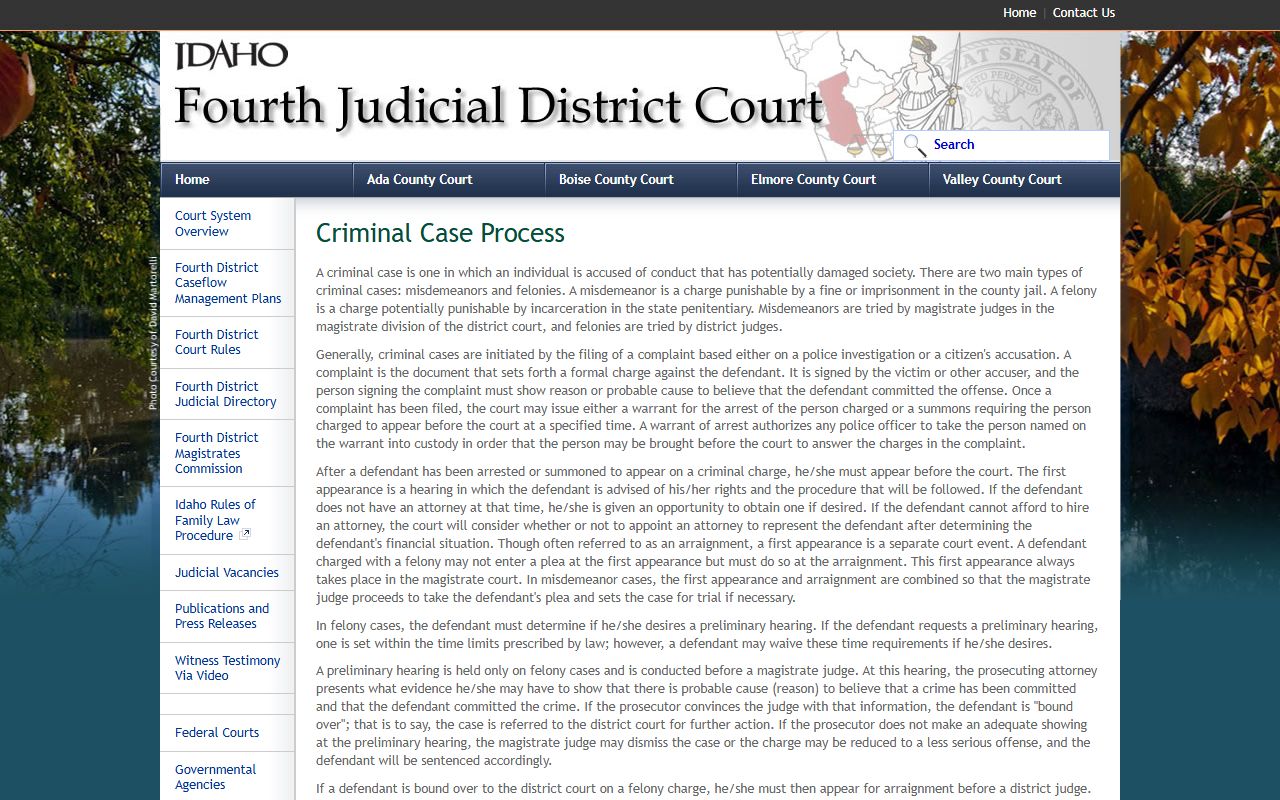
That process source is useful for reading a docket because the public record follows the same movement from filing to arraignment, motions, plea, trial, disposition, and sentencing.
How to Search Elmore County Criminal Court Records
The main online path is the Idaho iCourt Portal at mycourts.idaho.gov. Public users do not need registration for ordinary public case access. Registration is for extended access users who qualify under Idaho Court Administrative Rule 32 and Idaho Supreme Court extended-access orders. iCourt covers Idaho counties statewide, so use the location filter for Elmore County when the case is known to be local, and search more broadly when the filing county is uncertain.
- Open iCourt and choose Smart Search for case lookup or Search Hearings for criminal calendar events.
- Search by case number, or enter a defendant name in Last, First Middle Suffix format. The portal allows wildcard searching under its posted character rules.
- Use Advanced Filtering Options to narrow by location, case type, case status, filing date, party, judicial officer, or protection-order filters when those fields apply.
- Open the public case result and read the docket entries for hearings, charges, pleas, orders, disposition, sentencing, warrants, and payment events when public.
- For documents, certified copies, or FTR audio, submit the Elmore County Records Request Notice and Form or contact the Clerk of the District Court.
iCourt may show status and docket-level information without giving direct access to every document. Idaho Judicial Branch guidance says actual case records may be accessed through a courthouse kiosk or by requesting records from the clerk where the case was filed. Elmore's judicial records request form can be submitted at the courthouse or emailed to ElmoreRecordsRequest@elmore.idcourts.gov. Local fees listed on the form are $1.00 per page, $1.00 per document certification, and $10.00 per FTR audio CD, with payment required before release and a 3.5% card fee when paid by credit or debit card.
Stages of a Criminal Case
A criminal docket is easiest to read as a sequence rather than a pile of entries. An arrest, citation, complaint, information, or indictment can start the criminal process. The first court events address appearance, probable cause, bail, counsel, and scheduling. Later entries may show amended charges, motions, plea negotiations, trial settings, dismissal orders, judgment, sentence, fines, costs, probation terms, or warrants. A single case may include several charges with different outcomes, so the case status and each charge disposition should be read separately.
Case flow: Charges Filed › Initial Appearance › Arraignment › Preliminary Hearing or Pretrial › Motions › Plea or Trial › Disposition › Sentencing
| Stage | What Happens |
|---|---|
| Initial appearance | The court addresses identity, notice of charges, counsel, release conditions, and bail issues. Magistrate judges handle initial felony bail settings and misdemeanor proceedings. |
| Arraignment | The defendant is formally advised of the charge and enters a plea. The docket may show not guilty, guilty, or other plea events. |
| Preliminary hearing | For felony matters, the magistrate stage may determine whether probable cause supports moving the case toward District Court. |
| Pretrial and motions | Parties may file motions, responses, orders, continuance requests, discovery-related entries, or hearing notices. |
| Plea or trial | The case may resolve by plea, dismissal, amendment, or trial verdict. Each charge can have its own result. |
| Sentencing | The judgment may show jail or prison time, probation, fines, court costs, restitution, treatment conditions, or other court-ordered terms. |
What an Elmore County Criminal Court Record Shows
Public criminal case records can include the defendant, case number, court location, filing date, charges, bond, counsel, judicial officer, hearing schedule, docket entries, pleas, orders, judgment, sentence, fines, costs, probation terms, warrant events, and payment eligibility. iCourt also redacts personal identifiers such as Social Security numbers, addresses, telephone numbers, driver's license numbers, financial account numbers, and other personal identification numbers from public access.
| Field | What It Shows |
|---|---|
| Case number | The record number used for Smart Search, clerk requests, hearing searches, and some payment lookups. |
| Defendant | The person charged in the criminal case, subject to public-access and redaction limits. |
| Charges | The alleged offenses, charge level, statute or description, and later amendments or dismissals when public. |
| Bond | Cash bond, surety bond, release terms, or no-bond status if entered and public. |
| Plea | The defendant's formal response to each charge, such as guilty or not guilty. |
| Disposition | The outcome for a charge or case, including dismissed, guilty, acquitted, amended, or otherwise resolved. |
| Sentence | Jail, prison, probation, fines, costs, restitution, treatment, or other court terms imposed after conviction. |
| Docket entries | Chronological activity such as hearings, motions, notices, orders, warrants, continuances, and judgments. |
Elmore County's prosecutor page is a key source for the office that files and prosecutes criminal charges, and it is published at the Elmore County Prosecuting Attorney page.
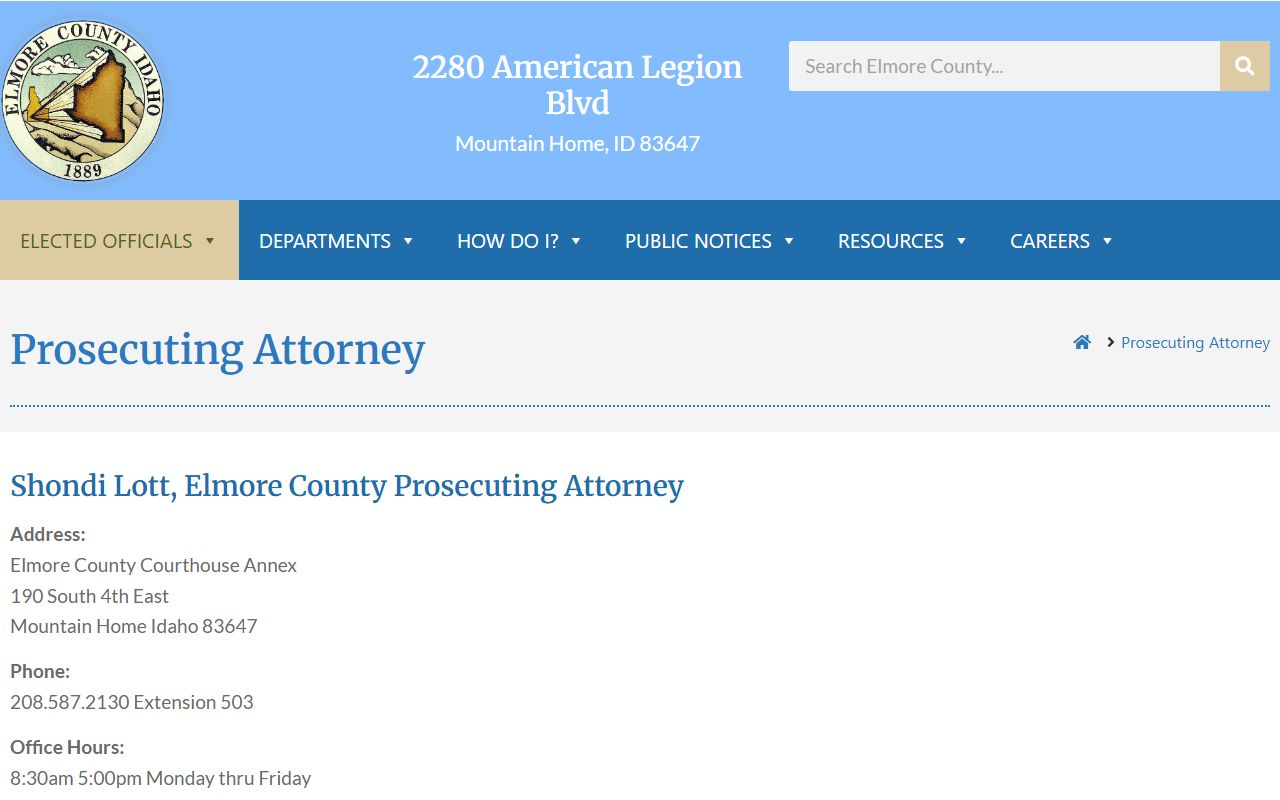
The prosecutor's office is relevant because charge decisions, amendments, dismissals, plea agreements, and sentencing recommendations can all affect what appears in a criminal court record.
Charges vs. Convictions
A criminal charge is an accusation filed or pursued in court. A conviction is an outcome after a guilty plea, verdict, or other judgment that legally establishes guilt. Elmore County criminal court records may show charges that were dismissed, reduced, amended, or tried without a conviction. For that reason, a charge list should not be summarized as a conviction history without reading the disposition for each count.
| Charge | Conviction | |
|---|---|---|
| Record point | Filed accusation or count in the case | Final guilty result by plea, verdict, or judgment |
| Proof level | Based on charging decision or probable-cause stage | Resolved under the criminal burden of proof |
| Possible outcome | Pending, amended, reduced, dismissed, or sentenced | Judgment and sentence, including fines, jail, prison, probation, or other terms |
| How to verify | Read the charge line and docket activity | Read the disposition, judgment, and sentence entries |
Reading Dispositions and Sentences
Disposition language is the key to the end result. A case may be pending even when several entries appear. A charge may be dismissed while another charge in the same case ends in conviction. A guilty plea may be followed by sentencing, probation, treatment-court supervision, fines, costs, or restitution. Idaho Code 19-2604 can also affect how some criminal cases later appear by allowing certain dismissal, set-aside, or related relief when statutory conditions are met, but the availability depends on the case and order entered by the court.
The Idaho State Public Defender maintains official contact information at the SPD contact page.
Public defense contact information is relevant to criminal records because counsel entries, appointment orders, and defense filings may appear on the court docket when public.
Elmore County's own public defender page points users to Idaho State Public Defender services, and that county source is available at the Elmore County public defender page.
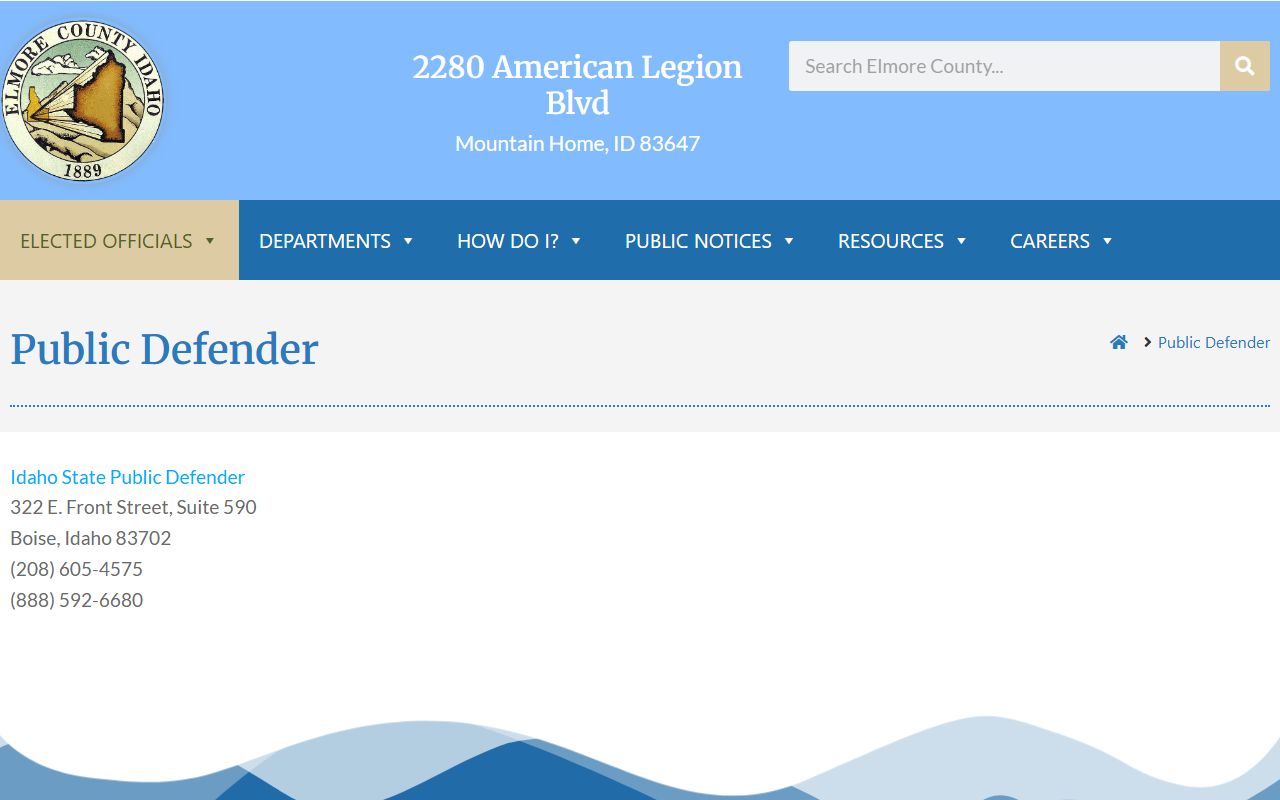
The county source and the statewide contact page should be reconciled because the research notes a current Elmore County Main Office in Mountain Home listed by the Idaho State Public Defender.
Sealed vs. Expunged Records
Idaho criminal-record visibility uses several specific mechanisms, including sealed records, shielded records, juvenile confidentiality, dismissal or set-aside relief, and redaction. The Elmore judicial records request form warns that sealed records may be denied and that some records may be redacted under Idaho Court Administrative Rule 32. Idaho content should avoid treating every record-relief issue as simple expungement because the court order, statute, case type, and disposition control public access.
| Sealed or Shielded | Dismissal, Set-Aside, or Expungement-Like Relief | |
|---|---|---|
| Visibility | Hidden or limited from ordinary public access by rule, statute, or court order. | May change public case status or record visibility depending on the Idaho statute and order. |
| Where handled | Through the court with case-number and access basis identified. | Through the criminal case court, often requiring a motion or qualifying order. |
| Public access result | iCourt may omit the case or restrict details, and the clerk may deny or redact a request. | The public record may still show limited history unless the specific law and order require a different treatment. |
Idaho Code 19-2604 is one criminal-record-relief source published at the Idaho Legislature statute page.
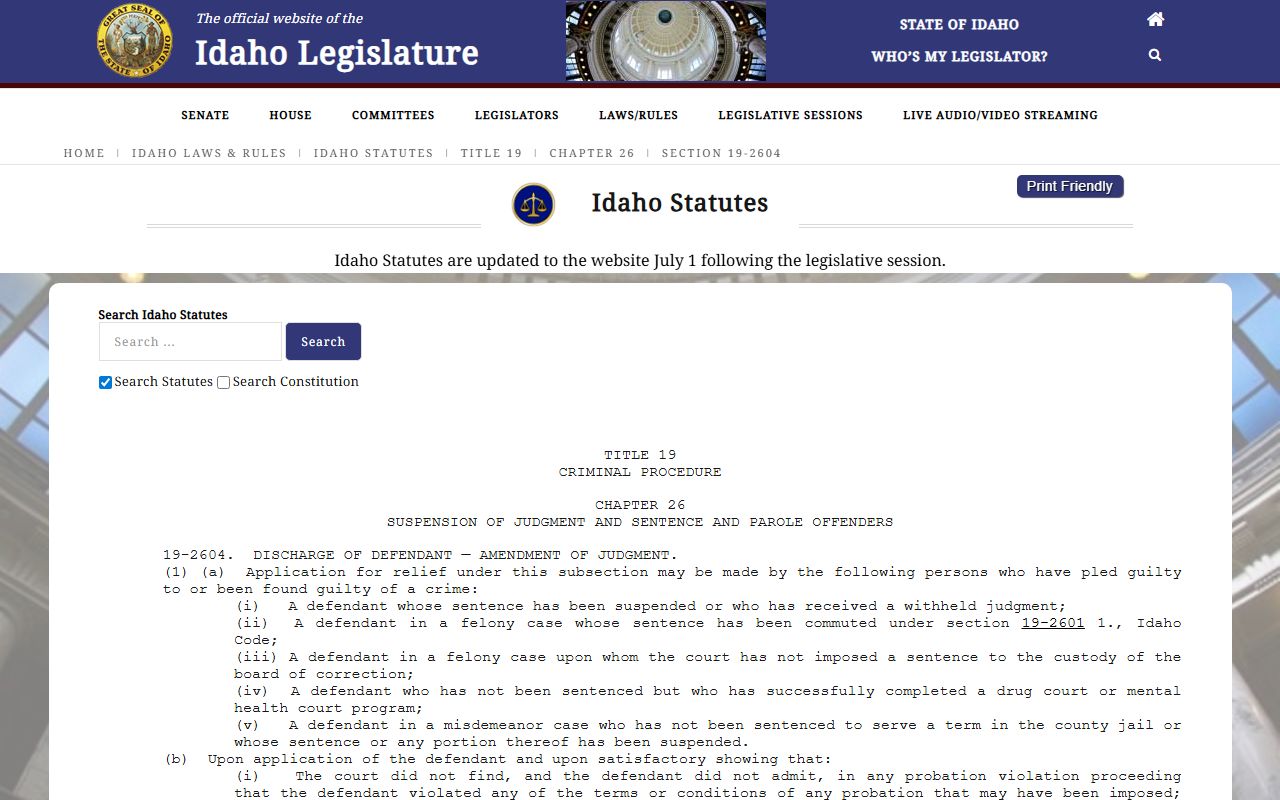
That statute is useful for understanding why a later court order may alter the way a criminal case appears, but it does not mean every criminal case can be removed from public view.
Public Access to Criminal Court Records
Access to Idaho judicial records is governed primarily by Idaho Court Administrative Rule 32. The public generally has access to court records from proceedings open to the public, including party indexes, case summaries, calendars, dockets, orders, judgments, and many filed documents. Non-judicial records held by the sheriff, prosecutor, county clerk, or other county offices are handled through Idaho's Public Records Act and the correct agency request form.
Key Authorities:
Idaho Court Administrative Rule 32 governs access to Idaho court records, exemptions, sealing, redaction, and restricted judicial records.
Idaho Code 20-525 restricts juvenile records and limits access to juvenile case information.
Juvenile confidentiality is published by the Idaho Legislature at Idaho Code 20-525.
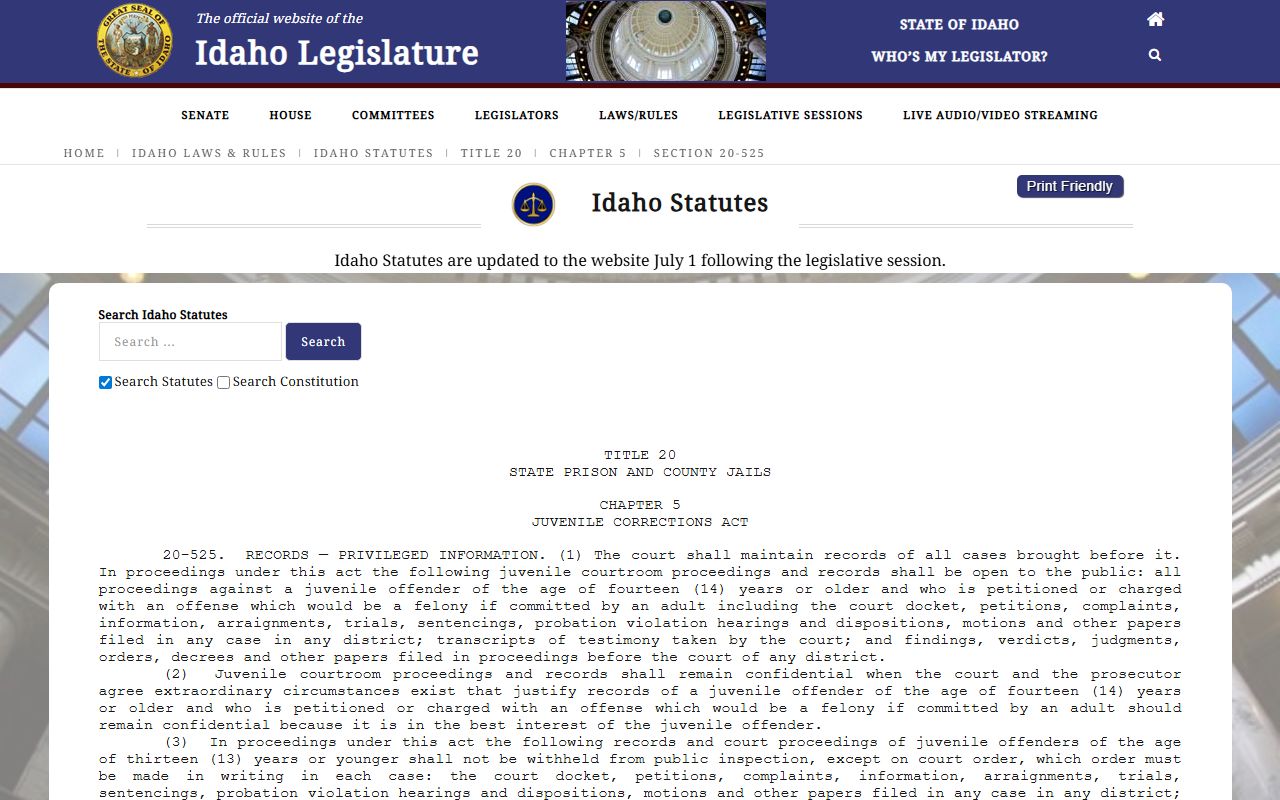
Juvenile records are a major exception to ordinary criminal-record access, so a missing juvenile entry should not be treated as proof that no case exists.
Background Check Considerations
Public court searches can confirm visible case activity, but they are not a substitute for an FCRA-compliant background check, a fingerprint-based criminal history process, or a government licensing review. Public iCourt results may omit sealed records, restricted juvenile records, personal identifiers, confidential filings, older retained records, or documents that must be requested from the clerk. Anyone using criminal court data for employment, housing, credit, insurance, licensing, or similar decisions should use the legally required process for that purpose.
Important: Public case lookup information is not an FCRA consumer report and should be verified with the originating court before reliance.
Restricted Criminal Court Records in Elmore County
Restricted criminal records include juvenile matters, sealed cases, shielded records, pre-sentence investigation reports, pretrial risk assessments, unreturned warrants, search-warrant support before return, grand-jury materials, wiretap materials, child-protective records, juror records, security plans, and records containing personal identifiers. When a user needs a restricted record, the Elmore request form requires a reason and relationship to the case. The clerk may deny, redact, or require a court order depending on ICAR 32, state law, and the judge's order.