
What Elmore County Court Dockets Show
A docket is the chronological case record. It lists events rather than replacing the case file. In Elmore County, public docket entries may show the case number, caption, filing date, case type, status, hearing settings, motions, orders, judgments, pleas, sentencing entries, continuances, warrants, and payments when those items are public. A docket can tell a reader what happened and when it happened, but it may not include the full motion, affidavit, order, exhibit, or audio recording.
Elmore County court dockets are tied to Idaho's unified District Court system. District Court handles felony criminal cases after preliminary stages, civil actions over $10,000, magistrate appeals, and judicial review. The Magistrate Division handles misdemeanors, infractions, traffic, small claims, family cases, probate, juvenile matters, guardianships, conservatorships, and protection orders. That local structure explains why a public docket may show either a district judge or a magistrate judge.
The District Judge Theodore Fleming calendar contact page is one county source for district-level calendar context.
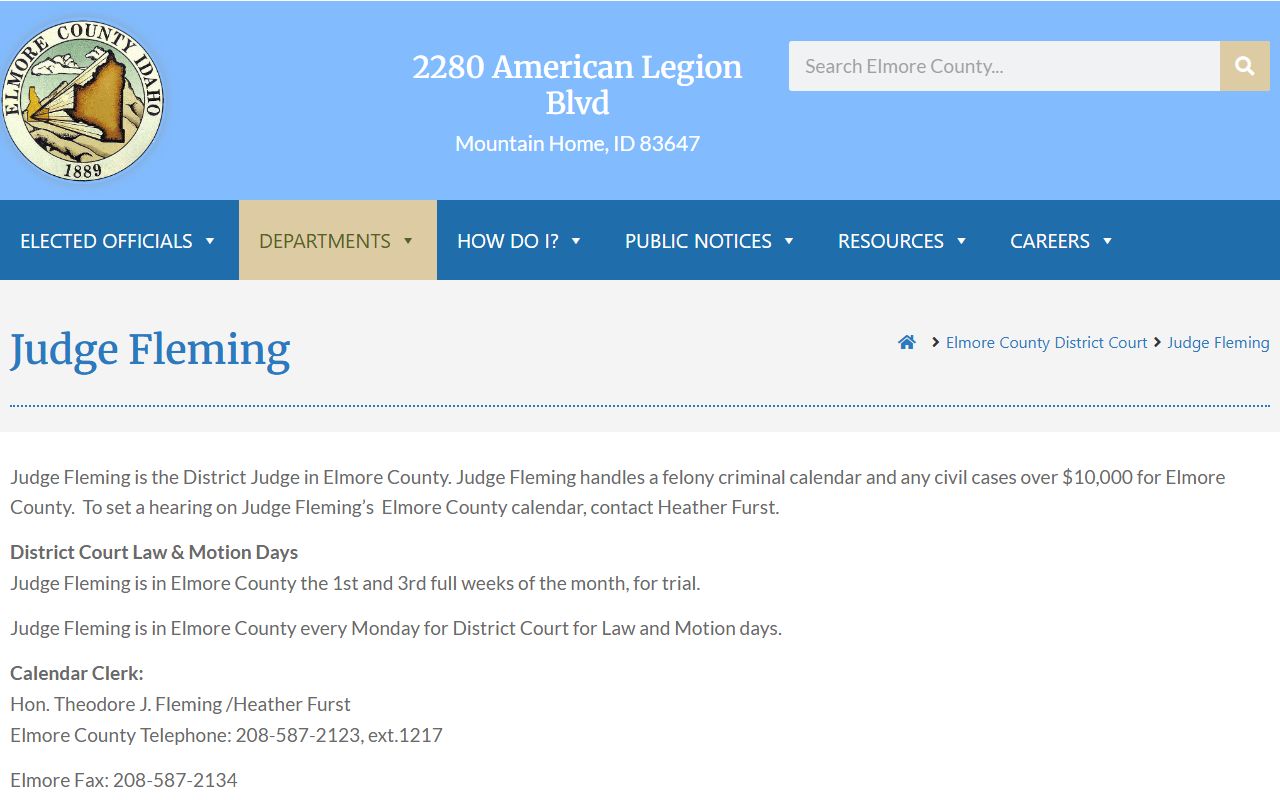
District judge calendar details help separate felony and higher civil settings from the magistrate calendars used for many daily docket events.
Search Elmore County Court Dockets Online
The main docket path is iCourt Search Hearings. Search Hearings is built for calendars and scheduled events, while Smart Search is built for case lookup. For Elmore County court dockets, Search Hearings lets the user select Elmore County, choose a hearing-type bucket, and search by case number, party name, business name, attorney, judicial officer, or courtroom.
- Open iCourt and select Search Hearings rather than Make Payments or Smart Search.
- Choose Elmore County as the location, then pick Elmore - All Hearing Types or a narrower hearing category.
- Select the search type, such as case number, party name, attorney name, judicial officer, or courtroom.
- Enter the search criteria and review the hearing date, time, case number, caption, location, and courtroom information.
- If the hearing exists but the filed document is needed, contact the Elmore County Clerk of the District Court.
The Magistrate Judge Brent Ferguson page gives county calendar contact context for magistrate matters.
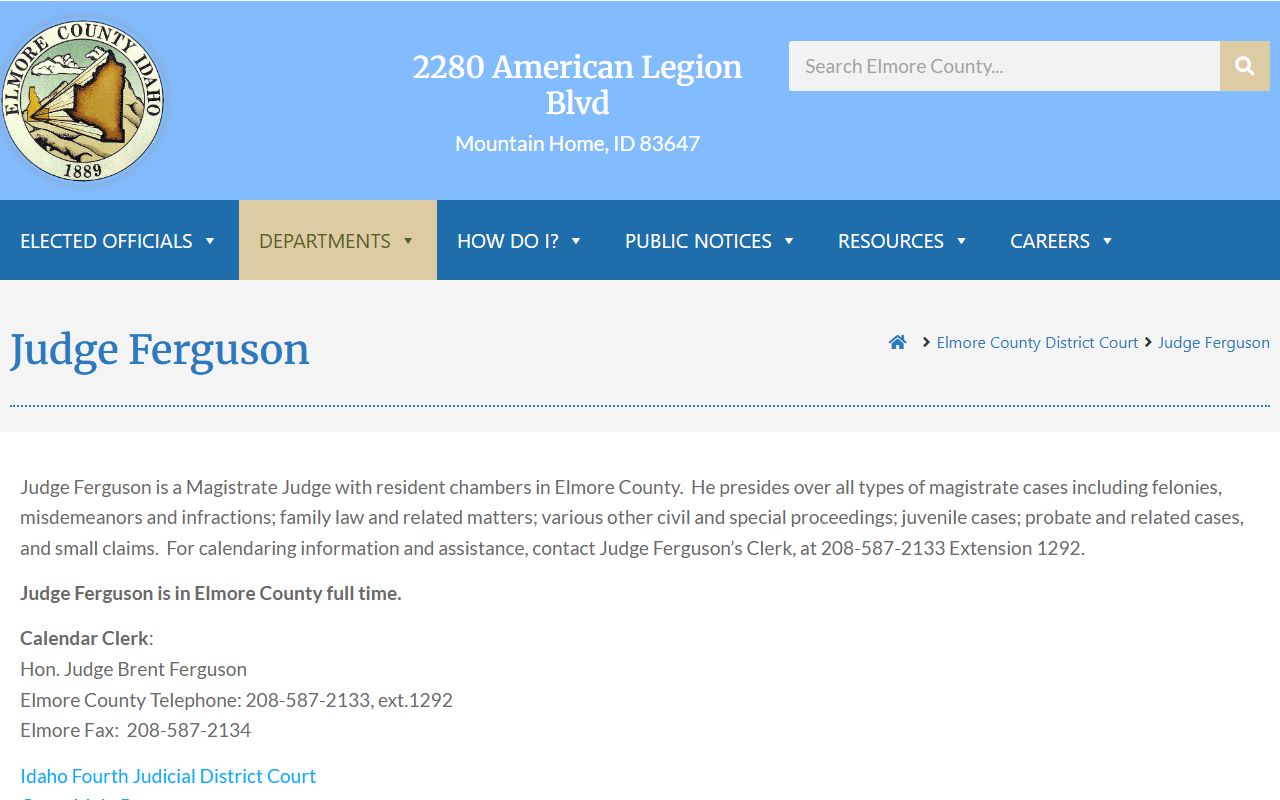
Magistrate docket work often includes misdemeanors, infractions, family, juvenile, probate, small claims, and preliminary felony events.
Elmore County Docket Search Fields
Search Hearings uses fields that are narrower than a full case search. The goal is not to pull every document. The goal is to find public hearing entries by location, hearing type, and search criteria. The Elmore hearing-type filters shown in the research include Elmore - All Hearing Types, Elmore - Civil, Elmore - Criminal, Elmore - Family, and Elmore - Probate or Mental Health.
| Field | What It Does |
|---|---|
| Select Location | Required field used to choose Elmore County or another Idaho county. |
| Select Hearing Types | Required field for all Elmore hearings or civil, criminal, family, probate, or mental health buckets. |
| Select Search Types | Required field for case number, party, business, attorney, attorney bar number, judicial officer, or courtroom. |
| Sounds Like | Optional name-search setting for spelling variations. |
| Search by Criteria | Conditional text field tied to the selected search type. |
| Judicial Officer | Conditional dropdown when the user searches by judge. |
The Magistrate Judge Brian Peterson page is another local source for Elmore magistrate calendar contacts.
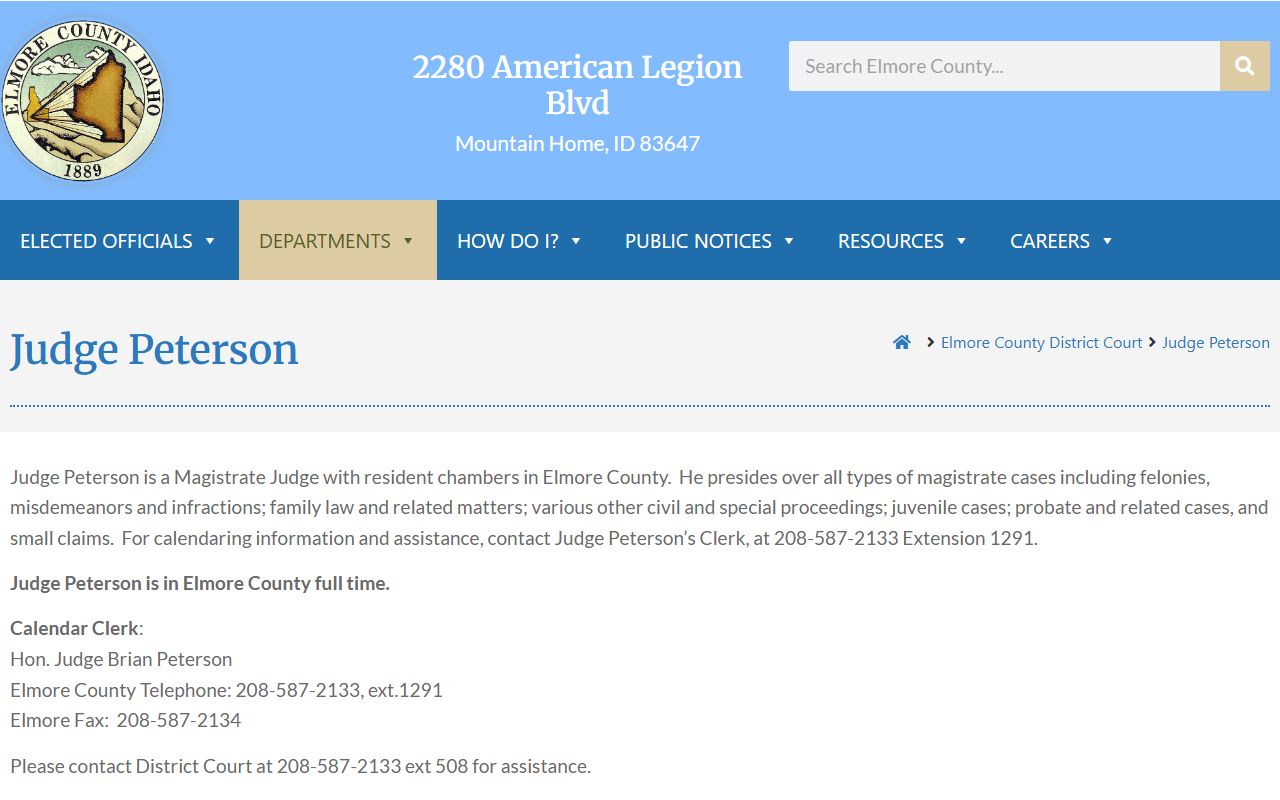
The judge listed on a docket can point a user toward the right calendar contact when a public hearing entry needs confirmation.
A hearing search result should be read with the case type in mind. A criminal hearing may be an initial appearance, preliminary hearing, arraignment, motion setting, plea, trial, sentencing, or review date. A traffic or infraction docket may point to a court trial, payment deadline, or failure-to-appear event. A family docket may list custody, support, divorce, or protection-order settings, while probate and mental health categories can include hearings that are public only in part. When the docket title is vague, the case number and court location are the best anchors for a clerk question.
Courts Behind Elmore County Dockets
Elmore County does not have a separate county court or justice court system. Idaho uses District Court with a Magistrate Division. Online public docket access is statewide through iCourt, while copy and case-file questions go to the local clerk. The local court table in the research identifies the Elmore County District Court, District Judge Theodore Fleming, Magistrate Judge Brent Ferguson, Magistrate Judge Brian Peterson, the Court Assistance Office, and Adult Drug & DUI Court / Justice Services as the main court-related contacts.
- Elmore County District Court handles district and magistrate trial-court functions and clerk contact for case records.
- District Judge Theodore Fleming is listed for felony criminal calendar work, civil cases over $10,000, and district law and motion.
- Magistrate Judge Brent Ferguson is listed for felony preliminary stages, misdemeanors, infractions, family, juvenile, probate, small claims, and civil or special proceedings.
- Magistrate Judge Brian Peterson has resident chambers and the same broad magistrate categories in Elmore County.
- The Court Assistance Office helps with civil self-help information and forms, but it does not give legal advice.
The Elmore County jury duty page adds practical courthouse rules that affect people appearing for trial dates.
Jury rules are relevant to dockets because trial settings can require appearance planning beyond the case search itself.
Elmore County courthouse rules can affect anyone with a hearing, not only jurors. County notices prohibit firearms, dangerous weapons, explosives, incendiary devices, bags, backpacks, and purses inside courthouse or annex spaces. Visitors may be subject to electronic and physical search. The jury page also says children are not allowed in the courthouse during jury service and that electronic devices are restricted for jurors. A person using a docket to plan attendance should verify the hearing, leave prohibited items outside, and call the court if an accommodation or calendar clarification is needed.
Docket vs. Elmore County Case Record
A docket is the index and timeline. A full case record is the file behind that timeline. A public docket may show that a motion, order, plea, hearing, or judgment exists. It may not provide the document text. For full records, Idaho Judicial Branch guidance points users to a county courthouse kiosk or a clerk request where the case was filed.
| Docket | Full Case Record | |
|---|---|---|
| Format | Chronological entries and hearing details. | Pleadings, motions, affidavits, responses, orders, judgments, and exhibits when public. |
| Access | Often searchable online through iCourt. | Usually through a courthouse kiosk or Clerk of the District Court request. |
| Use | Track dates, status, and next events. | Review the actual filed paper, certified copy, or audio request. |
| Limits | Sealed or confidential events may not appear. | Restricted documents may be denied or redacted. |
The Idaho juror questionnaire portal is separate from iCourt, but it is part of the official court attendance ecosystem for jurors summoned to serve.
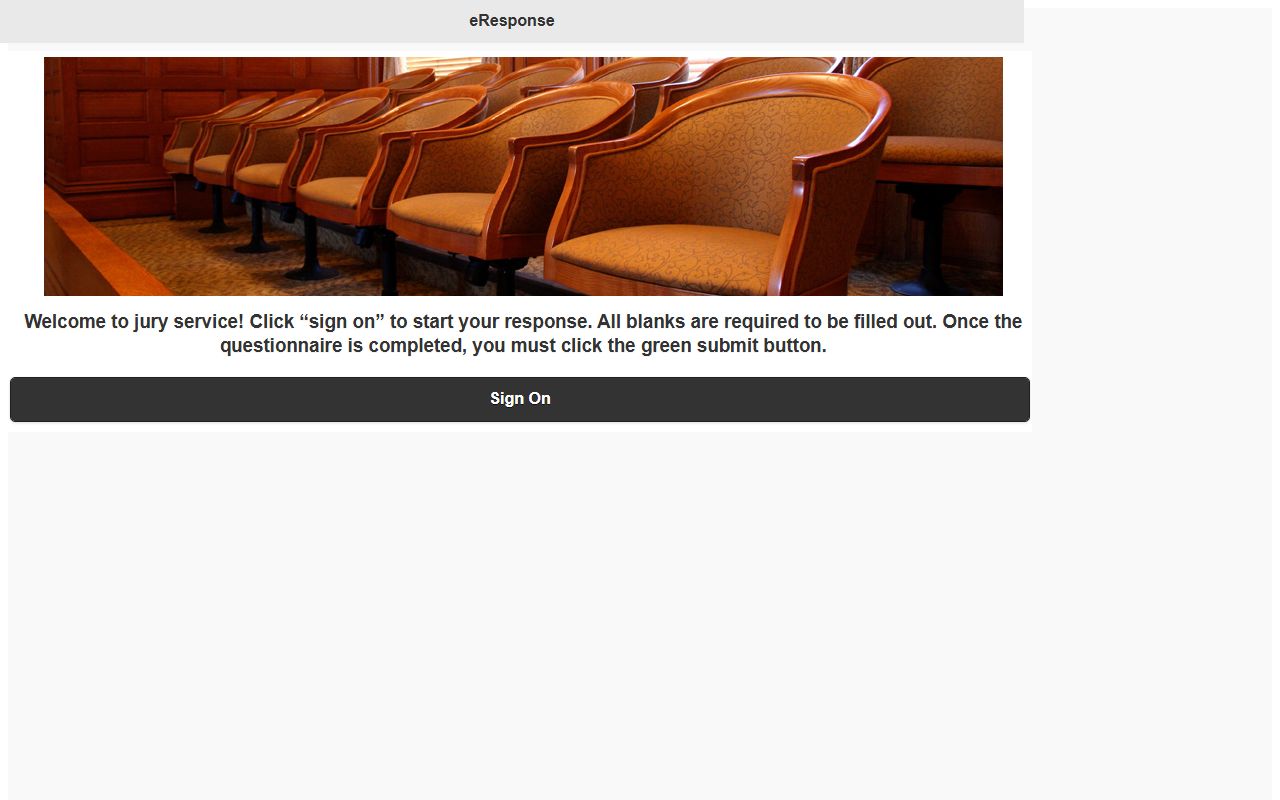
Juror tools do not search dockets, yet trial dates and jury service can intersect when a case reaches a public trial setting.
Read an Elmore County Docket
Start with the case number, court location, and case type. Those fields show whether the matter belongs to District Court or the Magistrate Division and whether it is civil, criminal, family, probate, mental health, traffic, or another category. Next, read the date order. A docket entry is a time-stamped event. Later entries may change earlier settings, continue a hearing, amend a charge, enter an order, or close a case.
Common terms should be read carefully. A disposition is the outcome of a charge or case. A motion is a request for a judge to act. A judgment is the final decision or order. A bench warrant is an order often tied to failure to appear. A sealed record is closed to public access by rule, statute, or order. Redaction means confidential details were removed from a public copy.
Missing entries do not always mean no event exists. Sealed cases, juvenile cases, protected identifiers, mental health details, some unreturned warrant materials, and restricted family or adoption material may be absent from public search. When a public docket shows a hearing but not the document, the clerk request path is the next step. For broader case summaries, use the Elmore County court records lookup process.
Older docket history also has practical limits. The Elmore judicial records form warns that some older files may not contain all documents because of age and statutory retention limits. That warning matters when a docket search returns a case but the clerk cannot produce every filing referenced in an older entry. It also matters when a person wants FTR audio, because the request must identify the hearing date and the form lists a separate audio CD fee. A clear docket entry can make the request faster, but it does not override retention, sealing, or redaction rules.
When a hearing date affects travel, bond, jury service, or payment timing, confirm the entry with the court before relying on an old printout. Dockets can change after continuances, settlements, plea settings, or cancellation of trial dates.
Idaho Code 74-103 is relevant to non-judicial public-record request timing and county response duties.
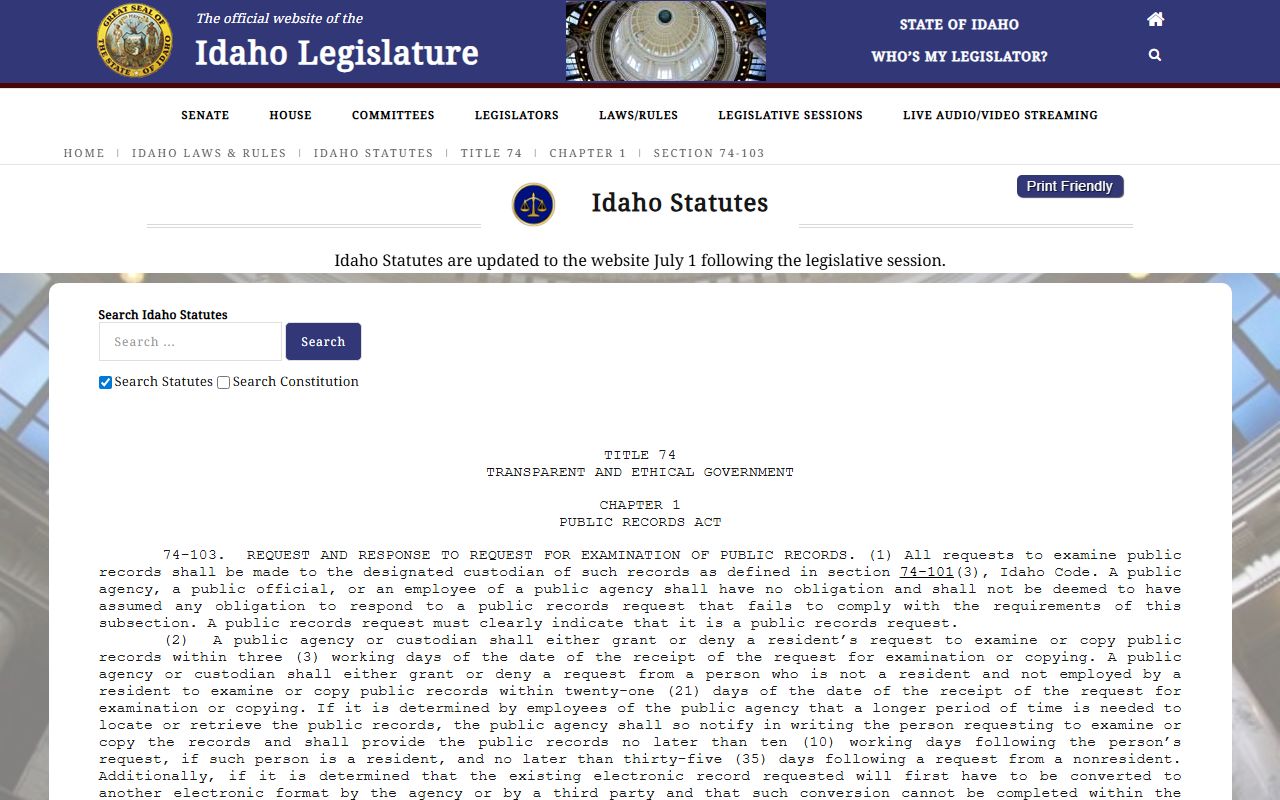
Judicial records still follow ICAR 32, but public-record timing rules can matter when the request is for county administrative records outside a court case file.